

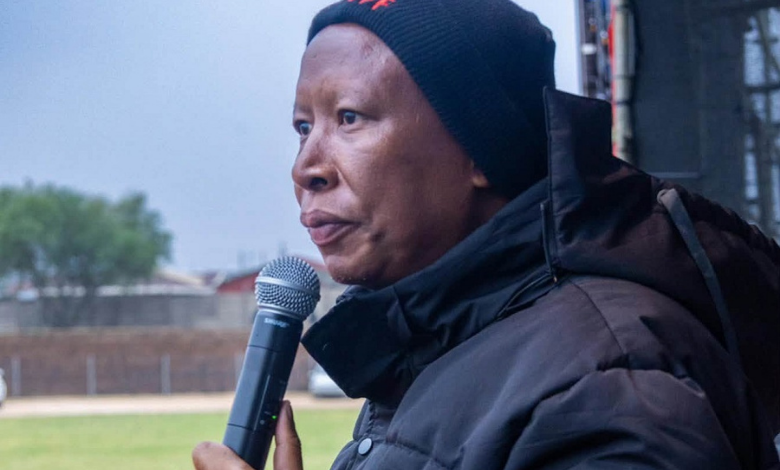
EFF leader Julius Malema has proposed increasing South Africa’s old-age grant to R4,500 a month, saying pensioners should receive substantially more financial support and arguing that government has enough money to fund higher grants.
Malema made the proposal at the EFF’s provincial manifesto launch in eMalahleni, Mpumalanga, on 5 September 2026, as political parties step up campaigning ahead of South Africa’s 4 November local government elections.
The proposal would represent an increase of R2,100 a month, or 87.5%, from the current maximum older person’s grant of R2,400.
How much is the SASSA old-age grant now?
The maximum older person’s grant is currently R2,400 a month following the increase introduced in April 2026.
Beneficiaries aged 75 and older receive an additional R20, bringing their maximum payment to R2,420 a month. The 2026 Budget allocated R292.8 billion to social grants for the financial year, supporting 26.5 million beneficiaries across the grant system.
Under Malema’s proposal, the standard old-age grant would rise to R4,500.
| Grant amount | Monthly payment |
|---|---|
| Current older person’s grant | R2,400 |
| Malema’s proposed amount | R4,500 |
| Proposed increase | R2,100 |
| Percentage increase | 87.5% |
The proposal is therefore substantially larger than the annual increases currently being implemented by government.
Malema says pensioners should receive more
Malema argued that pensioners, particularly grandmothers, play a central role in supporting South African families.
He told EFF supporters that the party would not remove SASSA grants if it came to power, but would instead increase them.
“We will not take away your grants, instead we will double them. In fact, we want it to start at R4,500.”
He argued that older people often support children and other members of their families financially, making increased support for pensioners a way of supporting wider households.
The EFF leader also claimed that government has sufficient resources to fund higher grants if public money is not misused.
The proposal comes ahead of local elections
The timing of the announcement is significant.
South Africa’s local government elections are scheduled for 4 November 2026, putting social grants, unemployment, poverty and the cost of living among the issues likely to feature prominently in political campaigning.
Malema’s proposal therefore remains an EFF political commitment, rather than a government policy change.
There is currently no announcement from National Treasury or the Department of Social Development indicating that the old-age grant will be increased to R4,500.
For existing SASSA beneficiaries, the current official payment remains R2,400 a month.
How much would a R4,500 grant increase cost?
The fiscal cost would be substantial.
An increase from R2,400 to R4,500 represents an additional R2,100 for every qualifying beneficiary each month, equivalent to R25,200 per beneficiary per year.
The total cost would depend on the number of older person’s grant beneficiaries at the time of implementation.
The scale of the proposal is important because South Africa already allocates hundreds of billions of rand to social protection. The 2026 Budget allocated R292.8 billion to social grants across all categories, rather than solely to the older person’s grant.
The government would therefore need to identify a substantial additional source of revenue or reprioritise existing expenditure if a near-doubling of the old-age grant were introduced.
Malema has argued that government can afford the increase by addressing what he describes as the misuse of public funds. However, the EFF has not, in the announcement, provided a detailed costing or funding plan for the R4,500 proposal.
Malema also targets support for unemployed South Africans
The EFF’s latest social protection proposals extend beyond pensioners.
Malema criticised the current Social Relief of Distress (SRD) grant of R370, arguing that it is insufficient for unemployed South Africans.
He has also called for an allowance or employment support for young people who leave school or university without finding work.
The SRD grant is currently funded through 31 March 2027, according to the latest information reported alongside the government’s social assistance programme.
These proposals would potentially expand the amount of government expenditure directed towards social protection and income support.
What would R4,500 mean for pensioners?
For an older person currently receiving R2,400, a R4,500 monthly grant would provide an additional R2,100 every month.
That would amount to R25,200 in additional annual income.
For pensioners who rely primarily on the state grant, such an increase could have a significant effect on their ability to pay for food, electricity, transport, healthcare and other household expenses.
The impact could extend beyond individual beneficiaries because many older South Africans support children and grandchildren from their grant income.
However, the economic benefit would need to be considered alongside the cost to the national budget.
The affordability question will be central
The biggest question surrounding the proposal is not whether pensioners would benefit from receiving R4,500. They clearly would.
The question is how the government would finance the increase without creating unsustainable pressure on public finances.
South Africa’s 2026 Budget already allocates a significant share of expenditure to the social wage. Government said social grants will support 26.5 million beneficiaries during the 2026/27 financial year.
A major increase in one grant category would therefore require careful consideration of the effect on government spending, revenue requirements and other budget priorities.
The proposal also comes at a time when the government is balancing social protection against spending on healthcare, education, infrastructure, public safety and debt-service costs.
What happens to the grant next?
For now, nothing changes for SASSA beneficiaries.
The official old-age grant remains R2,400 a month, with beneficiaries aged over 75 receiving R2,420.
Malema’s R4,500 proposal would require a policy decision and budget allocation before it could become an actual grant increase.
The EFF is expected to continue putting social grants and unemployment at the centre of its campaign ahead of the November local government elections.
For pensioners, the difference between the current R2,400 and the proposed R4,500 is significant. Whether the proposal can move from an election commitment to an affordable government programme will depend on the EFF’s ability to demonstrate how the additional expenditure would be funded.
